

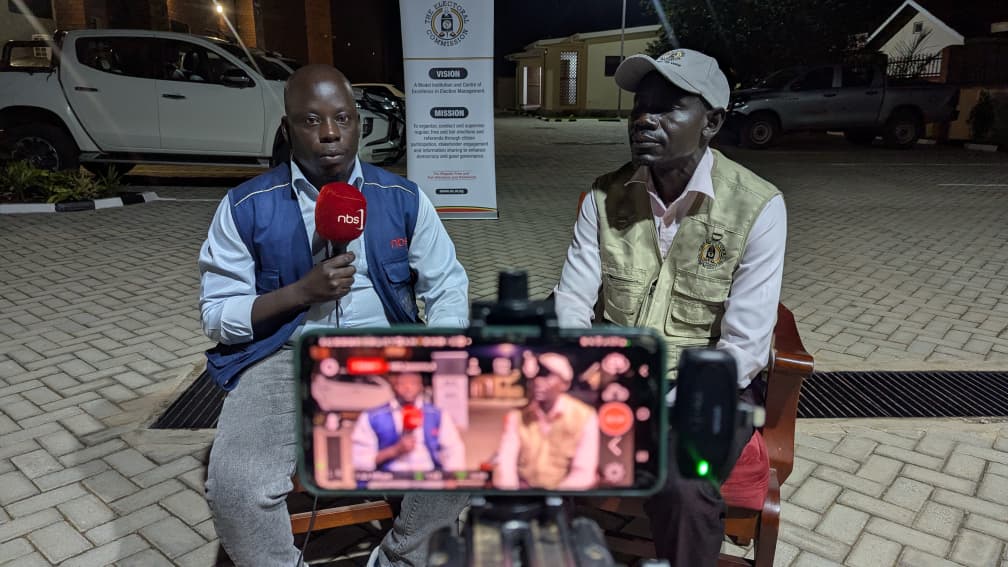
As a boy growing up in northern Uganda, Joseph Omagor was captivated by the mysterious voices that floated from his grandfather’s old radio.
“I wanted to know how and where these voices came from,” he recalls with a smile.
What began as childhood curiosity evolved into a lifelong passion for storytelling — one that would eventually take him from the dusty streets of Gulu to the rolling hills of West Nile, where he now serves as Bureau Chief for NBS Television.
A Calling in the Blood
Omagor’s interest in journalism deepened in the early 2000s when he learned that one of the most respected news anchors in Teso, Ejulut Michael — known on air as Icunyak — was his maternal uncle.
“That revelation made me realise journalism runs in my blood,” he says.
His professional journey began in 2013 at 96.9 Jal Fresh, a local radio station he joined alongside his friend and long-time collaborator, Benson Ongom. “From the first day we went on air, I knew the microphone would become my second home,” Omagor says.
From there, he honed his versatility — hosting shows, producing both audio and visual content, and writing for broadcast and print. His work took him from Jal Fresh to Radio King in Gulu and later to Youth Radio in Amuria, where he rose to the position of Programmes Director.
From Studio to Field
In 2017, Omagor made the leap from the studio to field reporting, joining Urban TV and Bukedde TV as a correspondent while contributing to the New Vision newspaper.
Six years later, fate came full circle. When his long-time colleague Benson Ongom left Next Media, Omagor stepped into his shoes as Bureau Chief for Northern Uganda. Today, he leads the network’s coverage of West Nile — a role he calls both demanding and deeply fulfilling.
West Nile: A Region of Stories, Strength and Spirit
“People who haven’t been to West Nile might think it’s just about the Lugbara and Alur,” Omagor says. “I was like that too — until I got here.”
Since his transfer to the region in mid-2025, he has been struck by its complexity and cultural depth. West Nile is home to more than ten tribes across 13 districts, two municipalities, and one city. “It’s a breathtaking blend of cultures, landscapes, and people whose stories are as deep as their roots,” he says.
But telling those stories is no easy task. Poor infrastructure, remote communities, and unreliable communication networks often make reporting a challenge. Yet, guided by the Next Media mantra — I Build Trust — Omagor perseveres.
“This region has been underreported for years,” he says. “Consistency and trust are everything here.”
That approach is paying off. In just a few months, his name and the NBS brand have become trusted voices across the region. “Now, stories are coming from all directions — and the issues West Nilers care about most are finally reaching the national conversation.”
Stories that Matter
Among Omagor’s most impactful reports is a feature on Arua City’s Revenue Transformation, which examined how local authorities addressed leakages and boosted collections to UGX 6.5 billion in the 2025 financial year.
Another highlight is his coverage of Cocoa Farming in West Nile, inspired by former MPs Bernard Atiku and James Acidri, whose initiative helped diversify livelihoods in one of Uganda’s poorest regions.
“That story stuck with me,” he says. “Every day, I want to see a happy, prosperous, and smiling population. Cocoa gives me hope — so much that I’ve even started sampling cocoa farming myself.”
A Vision for Peace and Progress
Omagor believes journalism has a vital role in fostering development and peaceful coexistence, especially in a border region like West Nile, which neighbours both the Democratic Republic of Congo and South Sudan.
“Take Salia Musala in Koboko, where Uganda, DRC, and South Sudan meet — people here trade and live across borders daily,” he says. “The media should amplify that spirit to strengthen East African integration.”
Beyond the Lens
Away from the newsroom, Omagor enjoys farming and spending time with family and friends. But the journalist’s adventurous side is never far away.
“Don’t be surprised to find me in a nightclub or showing off my one-pack at the waterfalls of Maracha,” he laughs.
For now, his mission remains clear — to give West Nile the platform it deserves.
As he often signs off: Twende Kazi! — “Let’s get to work.”
